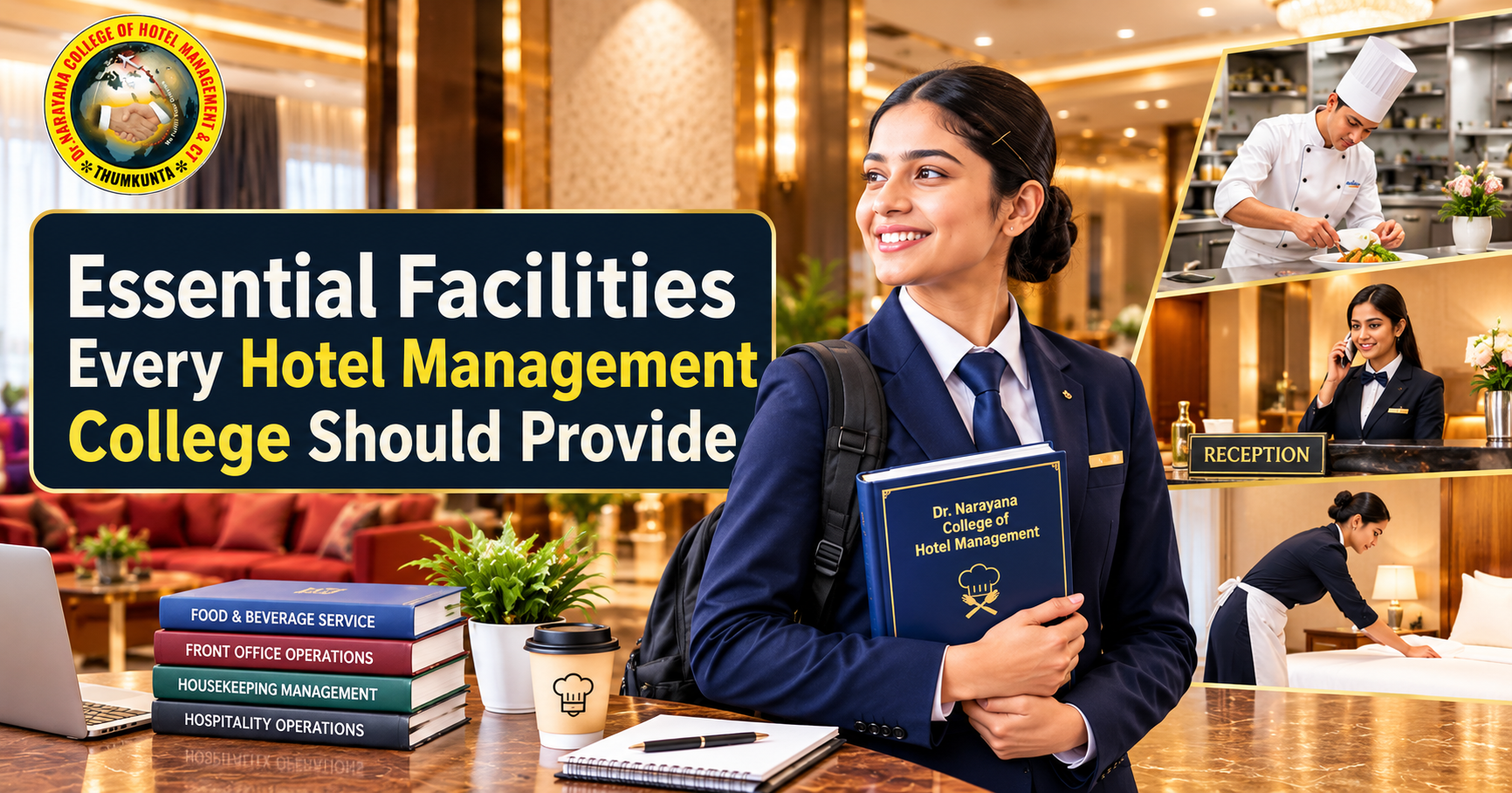
Essential Facilities Every Hotel Management College Should Provide
Choosing the right Hotel Management College is an important decision for students aspiring to build a successful career in the hospitality industry. Along with course curriculum, experienced faculty and placement opportunities, the facilities every hotel management college provides play a vital role in developing professional skills. Since hospitality is a practical industry, students need hands-on experience through modern training kitchens, front office labs, housekeeping labs and other essential facilities to understand how hotels, restaurants and hospitality businesses operate.
The right hotel management college facilities allow students to practise essential tasks, become familiar with professional equipment and develop confidence before entering the workplace. From professional kitchens and front office laboratories to housekeeping practice rooms and computer labs, every facility contributes to a student’s overall development.
For students exploring the best hotel management colleges in India, understanding the quality of campus infrastructure and practical learning opportunities can make the selection process easier. Let’s explore the essential facilities every hotel management institution should provide and how they contribute to hospitality education.
Why Are Facilities Important in a Hotel Management College?
Hotel management combines theoretical knowledge with practical skills. Students learn about food production, food and beverage service, accommodation operations, guest relations, hospitality administration and business management.
However, understanding these subjects through textbooks alone may not provide sufficient exposure to actual hotel operations. Students need dedicated learning spaces where they can practise professional procedures and understand industry expectations.
A well-developed hotel management college infrastructure supports:
- Hands-on learning through practical sessions.
- Familiarity with professional hospitality equipment.
- Better communication and guest-handling skills.
- Understanding of food preparation and service standards.
- Knowledge of housekeeping and accommodation operations.
- Confidence in handling real-world hospitality responsibilities.
These facilities make hospitality education more interactive and help students connect classroom concepts with practical applications.
10 Essential Facilities Every Hotel Management College Should Provide
1. Professional Hotel Management Training Kitchen
A professional kitchen is one of the most important facilities in a hotel management institution. Students pursuing food production and culinary-related subjects need regular exposure to kitchen equipment, cooking techniques and food preparation procedures.
A properly equipped hotel management training kitchen should provide:
- Commercial cooking ranges and ovens.
- Food preparation counters.
- Refrigeration and storage equipment.
- Cooking utensils and professional kitchen tools.
- Food safety and hygiene facilities.
- Separate preparation and cooking areas.
Students can practise different cooking methods, understand ingredient handling, learn kitchen organisation and develop food presentation skills.
Practical kitchen sessions also introduce students to teamwork, time management and coordination, which are essential in professional hotel kitchens.
2. Front Office Training Lab
The front office is often the first point of interaction between a hotel and its guests. Students must understand how reception operations, reservations, guest registration, check-in and check-out procedures work.
A dedicated front office training lab should recreate the basic environment of a hotel reception area.
Important elements include:
- Reception counters.
- Guest registration systems.
- Reservation and billing practice tools.
- Telephone communication facilities.
- Guest enquiry management practice.
- Hotel property management software, where available.
Through practical sessions, students learn how to communicate with guests, manage enquiries, maintain professional behaviour and understand front desk responsibilities.
This facility is particularly useful for students interested in front office operations, guest relations and hotel administration.
3. Housekeeping Training Facilities
Housekeeping is an essential department responsible for maintaining cleanliness, comfort and presentation standards in hotels.
The housekeeping training facilities in a college should help students understand how professional hotel rooms and public areas are maintained.
Essential training arrangements include:
- Model guest room setups.
- Bed-making and room preparation equipment.
- Linen and laundry management facilities.
- Cleaning tools and housekeeping supplies.
- Room inspection and maintenance practice areas.
- Storage and organisation facilities.
Students can learn bed-making techniques, room cleaning procedures, linen handling, room inspection and professional housekeeping standards.
A model guest room is particularly valuable because it allows students to practise room preparation in an environment that resembles actual hotel accommodation.
4. Hotel Management Training Restaurant
Food and beverage service is another major component of hospitality education. Students should understand how restaurants function, from preparing tables to welcoming guests and delivering professional service.
A dedicated hotel management training restaurant provides a simulated restaurant environment where students can practise service techniques.
The facility should ideally include:
- Dining tables and professional seating arrangements.
- Restaurant service equipment.
- Crockery, cutlery and glassware.
- Table setup and presentation facilities.
- Service stations.
- Guest interaction practice areas.
Practical restaurant sessions introduce students to table service, menu presentation, order-taking, service etiquette and guest satisfaction.
These activities also help students develop communication, coordination and customer service skills.
5. Hotel Management Computer Lab
Technology has become an important part of modern hospitality operations. Hotels use digital systems to manage reservations, guest information, billing, inventory and other operational activities.
A dedicated hotel management computer lab helps students understand the technological side of the hospitality industry.
A useful computer laboratory should provide:
- Computers with reliable internet connectivity.
- Hospitality management software.
- Reservation and billing practice systems.
- Basic office productivity applications.
- Digital learning resources.
- Access to relevant hospitality technology tools.
Students can develop computer literacy, understand digital hotel operations and become familiar with technology-based management processes.
Colleges that integrate digital learning and emerging technologies into their academic programmes can also help students understand how technology is changing hospitality services.
6. Advanced Bakery and Confectionery Training Facilities
Bakery and confectionery skills are valuable for students interested in culinary arts, pastry production and food businesses.
A dedicated bakery training area should provide equipment and workspace for practising baking techniques.
Important facilities include:
- Baking ovens.
- Mixing equipment.
- Preparation tables.
- Baking moulds and trays.
- Measuring tools.
- Refrigeration and ingredient storage.
Students can learn the basics of bread preparation, cakes, pastries, desserts and confectionery presentation through supervised practical sessions.
Such training encourages creativity while developing precision, consistency and an understanding of food production.
7. Modern Classrooms and Digital Learning Facilities
Practical learning must be supported by strong theoretical knowledge. Modern classrooms allow students to understand hospitality concepts through presentations, demonstrations, discussions and interactive learning.
Essential classroom facilities include:
- Smart boards or digital teaching equipment.
- Projectors and audio-visual resources.
- Comfortable seating arrangements.
- Proper lighting and ventilation.
- Internet connectivity.
- Space for group discussions and presentations.
Digital classrooms also help students understand subjects such as hospitality management, tourism, business communication and hotel administration.
8. Well-Equipped Library and Study Resources
A library is an important academic resource for hotel management students. It provides access to information beyond classroom sessions and supports independent learning.
A good hospitality college library should include:
- Hotel management textbooks.
- Culinary and food production reference books.
- Hospitality management publications.
- Tourism and travel resources.
- Business and communication materials.
- Digital academic resources, where available.
Students can use these resources to prepare assignments, complete research projects, understand hospitality trends and strengthen their subject knowledge.
9. Practical Industry Exposure and Internship Support
Campus facilities provide the foundation for learning, but exposure to professional hospitality environments is equally important.
Hotel management students should have opportunities to understand how actual hotels, restaurants and hospitality businesses operate.
Useful industry exposure opportunities include:
- Hotel internships.
- Industrial training programmes.
- Hospitality workshops.
- Guest lectures by industry professionals.
- Practical demonstrations.
- Industry visits and live projects.
These experiences help students understand workplace expectations, professional communication and operational responsibilities.
When comparing hotel management courses, students should ask how practical training and internships are incorporated into the academic programme.
10. Recreational and Student Development Facilities
Hospitality professionals work in team-oriented environments that require communication, confidence, discipline and interpersonal skills.
Apart from academic infrastructure, colleges should encourage activities that support students’ overall development.
Useful student development facilities and opportunities include:
- Sports and recreational spaces.
- Group activity areas.
- Communication and personality development sessions.
- Cultural activities.
- Team-building programmes.
- Leadership development activities.
These opportunities help students build confidence, improve teamwork and develop a balanced college experience.
How Does Hotel Management Practical Training Prepare Students for the Hospitality Industry?
Hotel management practical training helps students apply classroom knowledge to professional hospitality activities. Instead of only learning the procedures theoretically, students practise tasks in dedicated laboratories and simulated hotel environments.
For example:
Training Area | Skills Students Develop |
Training kitchen | Cooking, food preparation and kitchen management |
Front office lab | Guest communication and reception operations |
Housekeeping lab | Room preparation and cleanliness standards |
Training restaurant | Table service and guest handling |
Computer lab | Digital hotel operations and basic management systems |
Bakery lab | Baking, pastry preparation and presentation |
Regular practical sessions help students understand departmental responsibilities and the coordination required between different hotel operations.
This combination of theoretical learning, laboratory practice and industry exposure is an important factor when evaluating hospitality education.
What Should Students Check Before Choosing a Hotel Management College in Hyderabad?
Students searching for a hotel management college in Hyderabad should evaluate more than admission details and course fees. Visiting the campus and understanding the available learning facilities can provide a clearer picture of the educational experience.
Here are some important points to consider:
- Visit the practical training laboratories: Check whether the college has dedicated kitchen, front office, housekeeping and restaurant training areas.
- Understand the practical training schedule: Ask how frequently students participate in laboratory sessions and practical demonstrations.
- Check the available equipment: Make sure the facilities support the subjects taught in the programme.
- Evaluate faculty experience: Experienced faculty can help students understand professional standards and operational practices.
- Ask about industry exposure: Understand the availability of internships, workshops, hotel visits and industry interactions.
- Review the academic programmes: Compare the subjects, duration, eligibility and practical components of the available hotel management courses.
- Explore student support facilities: Check the library, classrooms, campus environment and student development opportunities.
Making these checks can help students choose an institution that supports both academic progress and practical skill development.
How Does Dr. Narayana College of Hotel Management Support Practical Hospitality Education?
Dr. Narayana College of Hotel Management (DRNCHM) focuses on combining academic learning with practical hospitality education.
Located at Thumkunta, Hakimpet, Secunderabad, the institution provides students with an environment designed to support hospitality learning and professional skill development.
Its campus facilities include:
- Advanced Training Kitchen: A dedicated practical learning space for understanding food production and kitchen operations.
- Housekeeping Service Lab: A facility where students can learn room preparation, cleaning standards and housekeeping procedures.
- Restaurant Lab: A practical environment for developing restaurant service and guest interaction skills.
- Advanced Restaurant Lab: A specialised training space for understanding restaurant service and hospitality operations.
- IT Lab: A technology-enabled facility that supports digital learning and computer-based training.
- Digital Classrooms: Learning spaces equipped with digital teaching resources.
- Library: Academic resources that support independent learning and subject knowledge.
- Playground: A recreational facility that supports student activities and overall development.
Along with its campus infrastructure, DRNCHM offers hospitality-focused academic programmes and practical learning opportunities. Students can explore its Bachelor of Hotel Management and Catering Technology, Tourism and Hospitality Management, and Diploma in Hotel Management programmes, among other options.
The college also emphasises industry exposure, professional development and career guidance as part of its approach to hospitality education.
For students comparing hotel management institutions, visiting the campus and exploring the available facilities can help them understand whether the learning environment matches their educational goals.
Explore Hospitality Education at DRNCHM
The right learning environment can make a significant difference in a student’s hospitality education. Professional training kitchens, front office laboratories, housekeeping practice rooms, restaurant facilities and digital learning spaces allow students to understand the different departments of the hospitality industry.
If you are exploring hotel management courses and looking for a college that combines classroom education with practical learning, Dr. Narayana College of Hotel Management is worth exploring.
Visit the campus, interact with the academic team and learn more about the facilities and programmes available.
Dr. Narayana College of Hotel Management (DRNCHM)
Address: Plot No. 45, NCL Colony, Thumkunta, Opposite Telangana Sports School, Hakimpet, Secunderabad, Telangana – 500078.
Phone: +91 9666 365 365
Email: nchm.bm@gmail.com
Website: https://www.drnchm.com/
Take the next step towards your hospitality education with DRNCHM.
FAQs
A good hotel management college should provide professional training kitchens, front office laboratories, housekeeping training rooms, restaurant service labs, computer laboratories, modern classrooms and a well-equipped library. These facilities help students gain practical knowledge of hotel operations.
Practical training helps students apply theoretical concepts to real hospitality activities. It develops skills in food production, guest handling, housekeeping, restaurant service, communication and hotel operations.
A hotel management training kitchen allows students to practise cooking methods, food preparation, kitchen organisation, food safety and presentation techniques using professional kitchen equipment.
Students learn reception operations, guest registration, reservation handling, check-in and check-out procedures, telephone communication and basic front desk management.
Housekeeping facilities provide hands-on experience in room preparation, bed-making, cleaning procedures, linen management and maintaining hotel cleanliness standards.
Keywords
- Hotel Management College Facilities
- Hotel Management College Infrastructure
- Hotel Management Practical Training
- Hotel Management Training Kitchen
- Front Office Training Lab
- Housekeeping Training Facilities
- Hotel Management College in Hyderabad
- Hotel Management Courses in Hyderabad
Recent Posts
-
Hotel Management Internship in Hyderabad – Placements, Training & Career
-
How to Become a Professional Bartender in India: A Complete Career Guide
-
BHMCT After 12th: Career Options & Future Scope
-
Is Hotel Management a Good Career in India in 2027?
-
Essential Facilities Every Hotel Management College Should Provide
-
Hotel Management Salary Per Month in India by Job Role
-
Hotel Management Course Duration: Diploma vs Degree